

Civil Protection Order Portal Design
Designing safer, more effective online protection order portals.
Courts are rapidly adopting online protection order systems, but many fail the people they are meant to serve. This project shows how human-centered, trauma-informed design improves safety and usability for survivors, while increasing court efficiency.
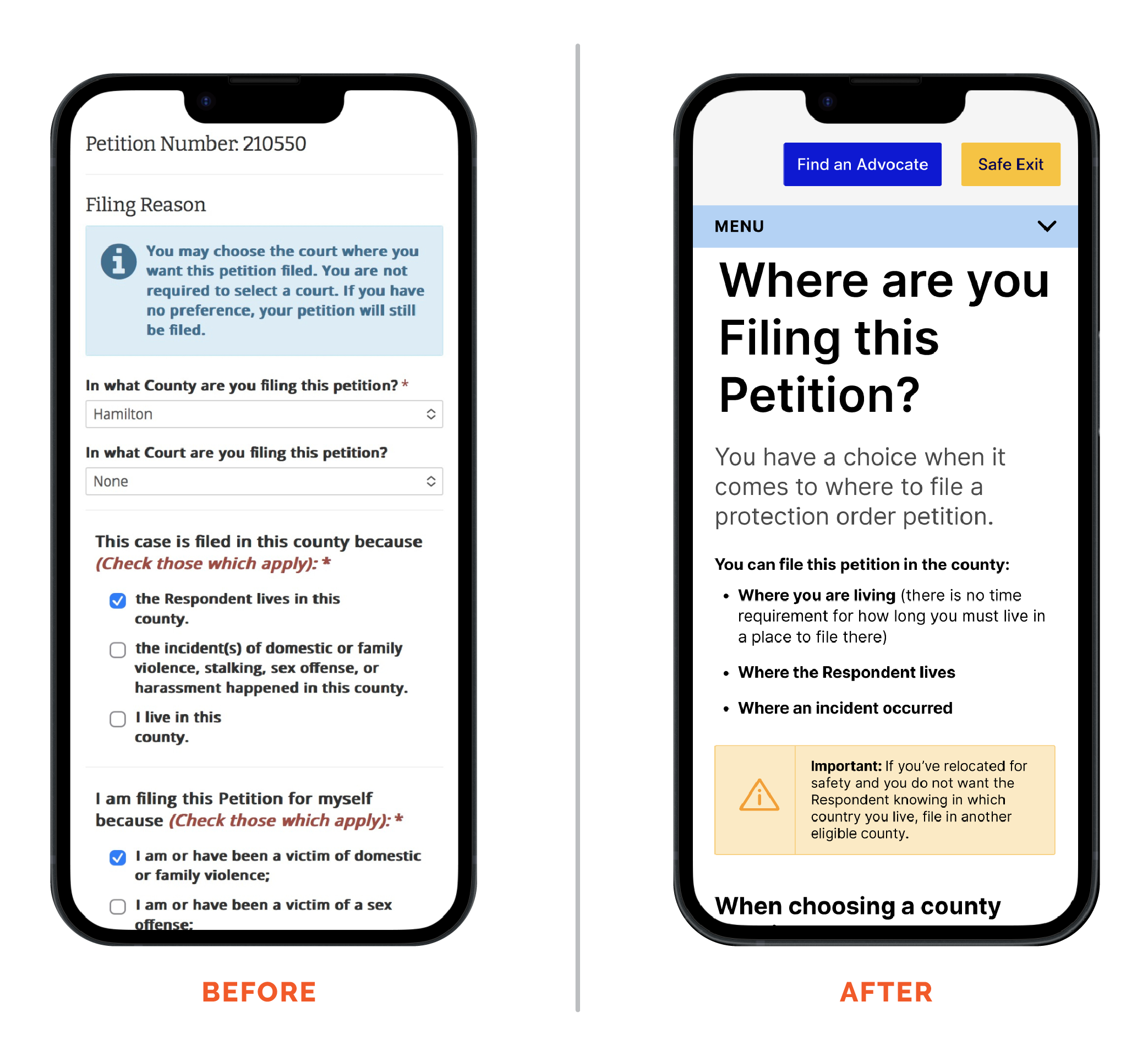
The challenge
Across the United States, most low-income survivors of domestic violence face urgent civil legal needs without meaningful support. Nearly all, 98%, will experience a civil legal issue this year, and 88% will receive inadequate or no legal help. Seeking a restraining order or civil protection order (CPO) can be a critical step toward safety, but most survivors navigate this process alone, without legal representation, facing complex paperwork, unfamiliar legal language, and systems designed for legal professionals rather than the people who need them most.
As a result, many survivors risk filing incomplete or incorrect CPO petitions, and many abandon the effort entirely. Domestic violence advocates must often serve as legal system navigators, and court staff often spend time correcting errors or rejecting petitions that don’t meet requirements.
Well-designed online court tools can expand access, improve safety, and increase court efficiency, but poorly designed ones can actually create new barriers. In response, i4J partnered with the National Center for State Courts on a three-year project to develop national guidance for design best practices for CPO portals, digital tools that enable survivors to safely and independently seek legal protection.
Impact
This project focused on designing portals that are clear and easy to navigate for people without legal training and who may be in crisis. The goals for the individual portals were to improve survivors’ safety and access in virtual CPO processes. The goal for the multi-year project overall was to share lessons learned with the national court community.
Over three years, this initiative:
Identified and addressed common barriers in online filing processes
Improved usability, legal understanding, and wellbeing for survivors completing petitions on their own
Supported courts in redesigning and creating more effective portals and processes
Developed research-backed design guidance adaptable across jurisdictions
Approach
Working alongside courts and within communities in multiple states, we conducted interviews, usability testing, and iterative prototype design and testing to determine data-driven recommendations for three statewide portals. Each of these projects produced research reports and iterative prototypes to showcase the new human-centered digital filing experiences.
This work followed a clear progression from exploration to evaluation to new design:
Year 1 (Nevada): Understand survivor needs and explore potential portal solutions
Year 2 (Indiana): Evaluate and improve an existing system
Year 3 (Wisconsin): Design a new human-centered solution from the ground up
Insights from all three phases informed the development of national design guidance for CPO portals.
Guidance
These resources help courts and partners design and improve CPO portals to better serve survivors and simplify court systems. Following the design guidance and engaging in your own collaborative design process can help courts increase access to justice and enhance survivor safety while at the same time reducing rejected or incomplete filings and improving efficiency for staff.
Visit SSRN to download Civil Protection Order Portal Design: Designing Safe and Usable Online Protection Order Portals and apply the design guidance in your jurisdiction.
The sections below highlight key findings and design contributions from each year of the project.
Year 1: Nevada
Understanding Survivor Needs and Barriers and Exploring Portal Solutions
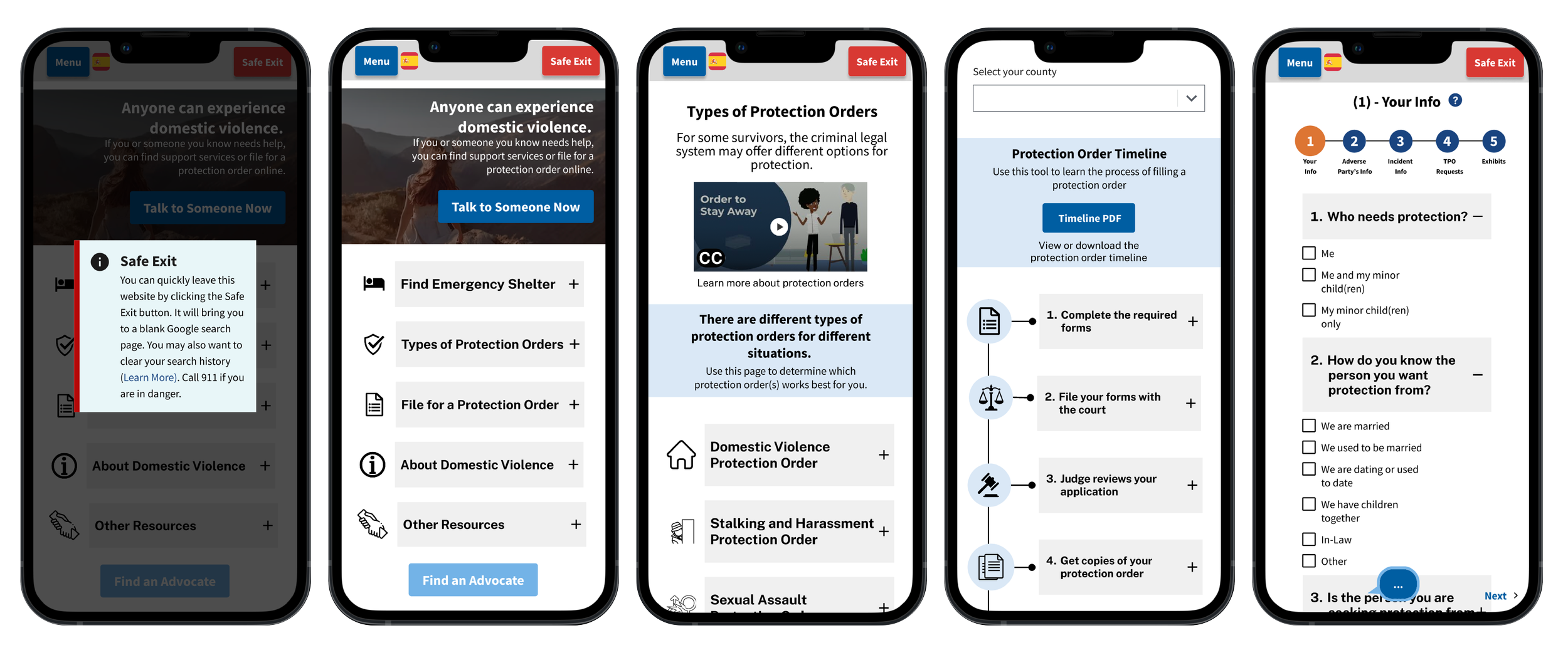
In 2023, i4J partnered with the Nevada Supreme Court’s Administrative Office of the Courts to explore how a statewide CPO portal could better serve survivors. In Nevada, where rates of domestic violence are among the highest in the nation, access to a safe, clear, and usable filing process is especially critical. This phase focused on understanding survivor needs and barriers, and surfacing opportunities to improve the experience.
The team interviewed survivors, advocates, and court system actors to understand how people currently navigate the CPO process and where breakdowns in the process occur.
Key insights included:
Survivors often struggle to navigate fragmented resources and unclear filing pathways
Safety concerns, such as privacy and risk of retaliation, directly shape how survivors engage with online systems
Survivors in rural areas face additional barriers, including limited access to technology and support services
Design responses explored:
Guiding survivors step-by-step through the filing process
Integrating legal information and support resources into the workflow
Reducing cognitive load during high-stress moments
This phase tested prototype designs and produced actionable design recommendations that informed Nevada’s portal development and also contributed directly to statewide court website design guidance. Insights from this project highlight common challenges courts may face when building new systems, and present data-driven recommendations that can be applied by any jurisdiction.
Explore the work:
UX Discovery Final Report: Nevada Protection Order Portal (full report)
UX Discovery for Nevada’s New Domestic Violence Protection Order Portal (2-page brief)
Nevada CPO Portal Prototype (interactive prototype)
Year 2: Indiana
Evaluating and Improving an Existing Statewide System
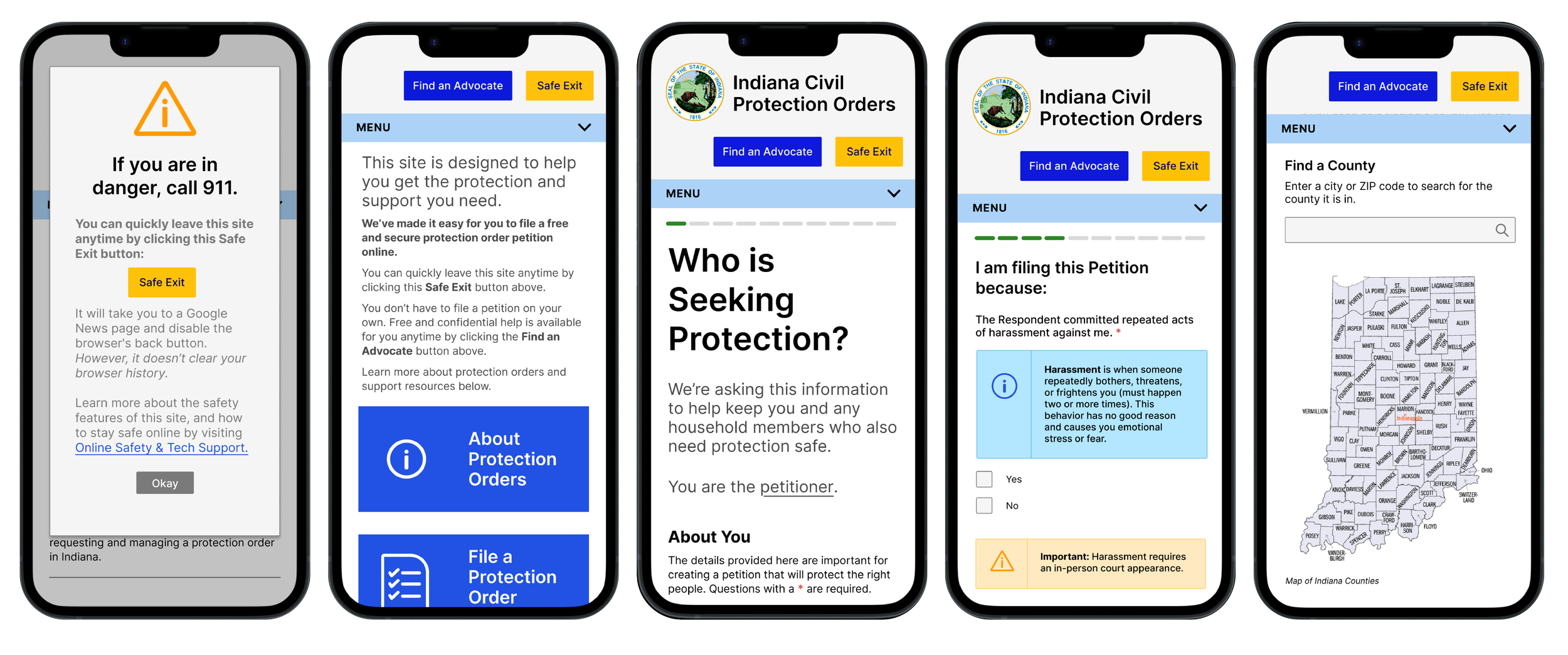
In 2024, i4J partnered with the Indiana Supreme Court to evaluate its existing CPO portal. Indiana operates a mature, statewide system with integrated e-filing court infrastructure, making it a valuable opportunity to assess how a live system performs for real people at scale. This phase focused on identifying usability challenges and improving a system already in use across the state.
The team conducted interviews and usability testing to identify challenges in the user interface and functionality that create barriers to completion.
Key insights included:
Confusing navigation and resources spread across separate sites
Legal language that is difficult for self-represented survivors to understand
Points in the process where survivors are more likely to make errors or abandon filing
Design responses focused on:
Streamlining workflows to reduce confusion
Improving language clarity for self-represented survivors
Reducing errors that delay or prevent successful filings
The redesign applied trauma-informed design principles to streamline and simplify the experience and reduce stress. The result was a more intuitive and accessible system for survivors, which should improve efficiency for courts through more complete filings, fewer errors, and fewer help requests. Insights from this phase informed national design guidance and highlight common usability challenges courts may encounter when evaluating existing systems.
Explore the work:
UX Evaluation Report: Indiana Civil Protection Order Portal (full report on SSRN)
Indiana Civil Protection Order Portal Project Brief (2-page brief)
Indiana CPO Portal Prototype (interactive prototype)
Year 3: Wisconsin
Creating a New, Integrated Solution from the Ground Up
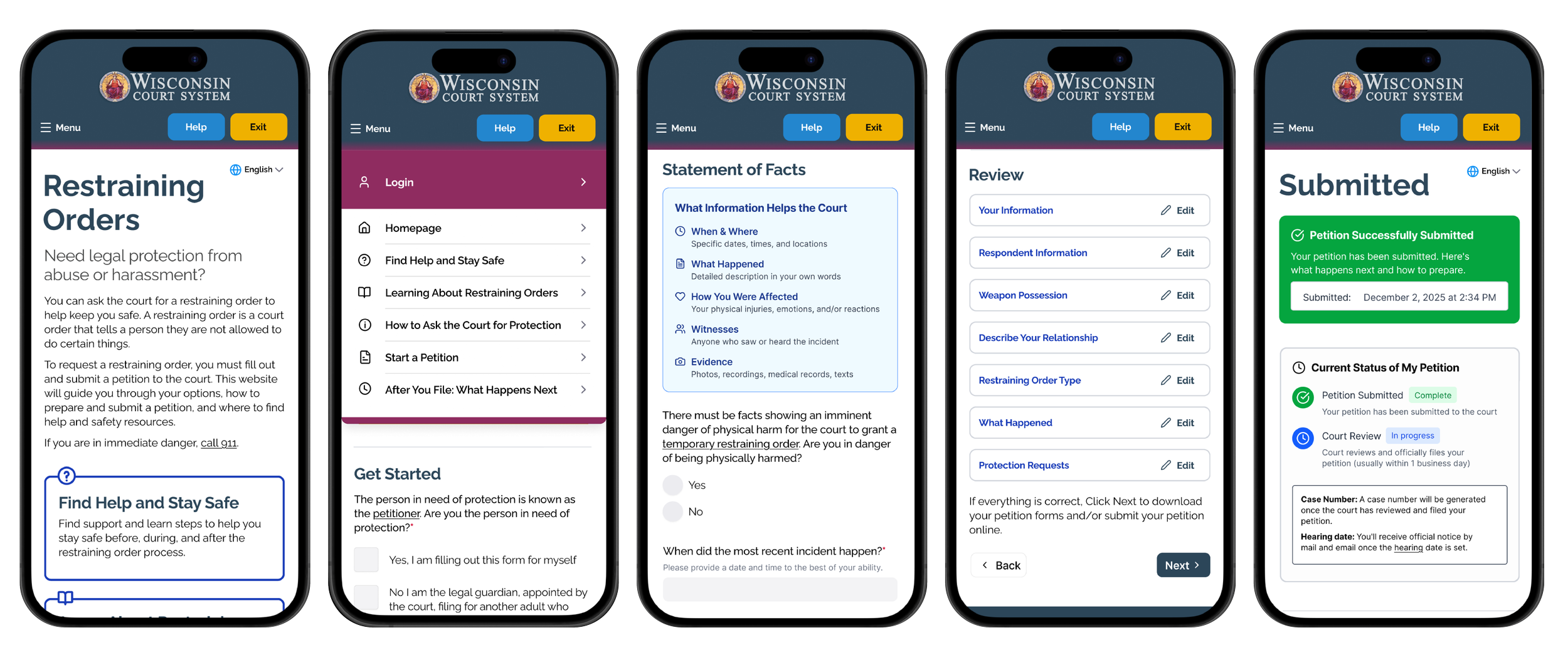
In 2025, i4J partnered with the Wisconsin Court System to design a new, fully integrated CPO order portal that better serves both survivors and courts. Building on insights from Nevada and Indiana, this phase reimagined the survivor experience from start to finish using trauma-informed tech design best practices.
In Wisconsin, filing a CPO, which is called a restraining order there, involves filling out multiple repetitive paper forms and filing in person, or navigating two separate complex websites, which are not mobile friendly or made with self-represented litigants in mind, to file online.
The i4J team examined how survivors move through the full CPO order process, from filing to next steps in court, identified where frustration and confusion occur, and focused on reimagining the experience from start to finish, designing a system that supports survivors holistically while aligning with court operations.
Key insights included:
The process is fragmented across forms, systems, and filing steps and the options are not clear
Survivors must navigate complex legal processes without clear explanations of the steps involved
Support resources are inconsistent and not integrated into the survivor experience
Design responses focused on:
Guiding survivors through the full process in one cohesive experience
Integrating legal information, court requirements, and support resources into the workflow
Enabling a seamless e-filing option
This phase demonstrates how courts can move beyond improving individual steps to designing end-to-end digital experiences that better support both survivor and court staff. It provides a forward-looking model for building modern, human-centered court technology.
Insights from this work directly informed national design guidance and offer practical direction for courts developing new systems.
Explore the work: Coming soon!
UX Discovery Report: A New Wisconsin Restraining Order Portal (full report on SSRN)
Wisconsin Civil Protection Order Portal Project Brief (2-page brief)
Wisconsin CPO Portal Prototype (interactive prototype)
Bring this work to your court or organization
i4J works with courts, legal service providers, and community organizations to design and improve justice system technology.
We can help you:
Conduct UX discovery research
Evaluate existing technologies and systems
Facilitate cross-stakeholder design processes
Develop trauma-informed digital tools
Translate research into implementation plans
Contact us today to learn more about how you can partner with i4J’s System Impact Area.
System Impact Area Projects
UX Evaluations: A Continuum of UX Innovation in Utah

UX Discovery: Nevada’s Domestic Violence Protection Order Portal
UX Discovery: Michigan's Office of Child Support
UX Evaluation: Alaska's Benefactor for SSD Applications
Back to System Impact Area.